
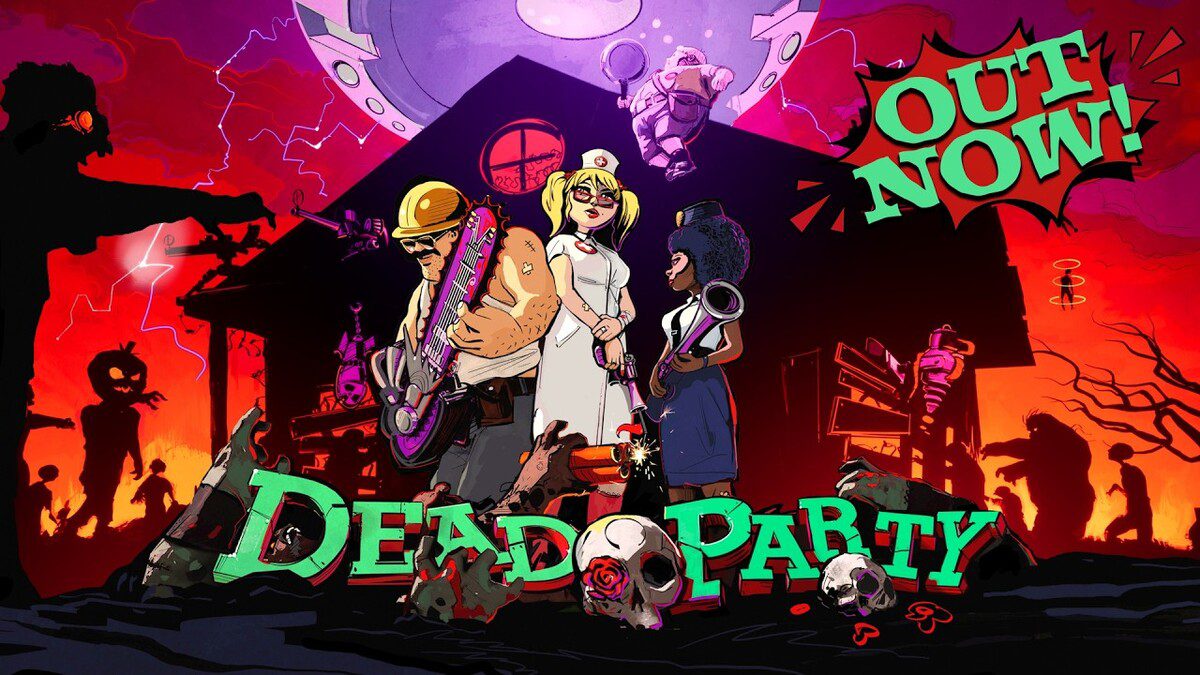
There was a time when cooperative games didn’t need sprawling battle passes, endless progression mechanics, or live-service roadmaps to justify their existence. Sometimes all a game needed was a group of friends, a ridiculous premise, and enough chaotic action to keep everyone laughing for hours. Dead Party, developed by Radiation Blue and published by Snail Games USA, embraces that philosophy wholeheartedly, delivering a colorful cooperative zombie defense experience filled with cartoon violence, UFO invasions, and just enough strategic depth to keep things engaging. Released on October 29, 2026, the game combines arcade-style action with party-game accessibility and base defense mechanics.
The result is not a revolutionary multiplayer experience, but it rarely attempts to be. Instead, Dead Party focuses on creating memorable moments between players, and in that regard, it succeeds far more often than it stumbles.
Halloween Meets Alien Invasion
The premise is delightfully absurd.
On Halloween night, mysterious UFOs appear above the sleepy town of Shady Hill. Shortly afterward, the local cemetery population decides to stop being dead, forcing four unlikely heroes into a desperate battle against waves of undead invaders and their extraterrestrial masters.
Rather than pursuing a grim survival-horror atmosphere, Dead Party leans heavily into comedy and cartoon aesthetics. The colorful visual style immediately communicates that this adventure is more about fun than fear. Zombies may be everywhere, but they’re designed to entertain as much as intimidate.
That lighter tone works in the game’s favor. It gives Dead Party an identity that separates it from the countless serious zombie shooters currently available on PC.
Cooperative Gameplay Takes Center Stage
At its core, Dead Party is a cooperative defense game.
Players work as a team of up to four heroes tasked with protecting buildings and important objectives from relentless zombie attacks. While individual combat skills matter, success depends far more on coordination, resource management, and efficient teamwork.
The game’s biggest strength is that it constantly encourages players to cooperate without turning every encounter into an overly complicated tactical exercise. One player may focus on barricade maintenance while another manages crowd control. Someone else might gather resources or handle stronger enemies.
These responsibilities emerge naturally through gameplay rather than being artificially enforced by character classes or restrictive systems.
This flexibility makes every session feel dynamic and keeps players engaged throughout longer matches.
More Than Just Zombie Shooting
The game’s defense-focused structure introduces an additional layer of strategy beyond simply eliminating enemies.
Zombies attack buildings through windows and barricades, forcing players to actively maintain their defenses while managing incoming threats. Certain enemies introduce additional challenges that require quick thinking and teamwork. According to developer descriptions and community guidance, players must contend with armored zombies, explosive enemies, poisonous undead, energy-shielded attackers, and even support units that strengthen nearby hordes.
These enemy variations add welcome diversity to each encounter.
Instead of treating every zombie as interchangeable cannon fodder, Dead Party introduces threats that demand specific responses. Some should be eliminated immediately, while others force players to reposition or prioritize different objectives.
The result is a satisfying blend of action and tactical decision-making.
Arcade Action Done Right
One of Dead Party’s greatest achievements is understanding pacing.
Matches move quickly. Combat feels responsive. Objectives remain clear. Progression is immediate.
Too many cooperative games drown players in systems, currencies, unlock trees, and weekly challenges. Dead Party takes the opposite approach, emphasizing simple mechanics executed well.
The arcade-inspired design allows players to jump into sessions without needing hours of preparation or tutorials. New players can quickly understand their role while experienced teams can focus on optimizing their strategies and maximizing efficiency.
This accessibility makes the game particularly attractive for groups looking for weekend multiplayer sessions without a significant time commitment.
Story Mode and Replayability
Dead Party includes both a Story Mode and customizable Arcade Mode. Story Mode follows the heroes as they battle through the zombie apocalypse using what the developers describe as “the power of rock music,” while Arcade Mode allows players to jump directly into action-focused gameplay.
The inclusion of multiple modes significantly improves replay value.
Story Mode provides structure and context, whereas Arcade Mode becomes the ideal destination for players who want to refine strategies, chase high scores, or simply enjoy repeated cooperative sessions with friends.
Games in this genre live or die on replayability, and Dead Party appears aware of that reality from the outset.
Visual Style and Presentation
Dead Party’s visual direction may divide players, but it effectively serves the gameplay.
The colorful, cartoon-inspired art style ensures that the screen remains readable even during chaotic encounters filled with enemies, effects, and environmental interactions. Player characters, threats, and objectives remain clearly visible, reducing the confusion that often plagues co-op action games.
The stylized presentation also gives the game a timeless quality.
Rather than chasing photorealism, Dead Party prioritizes clarity and personality. That decision should help the game age more gracefully than many technically ambitious competitors.
Where Dead Party Falls Short
While the game offers considerable entertainment value, it isn’t without limitations.
Players seeking a deep narrative experience may find the story secondary to the cooperative gameplay loop. Similarly, those looking for highly competitive multiplayer systems or extensive RPG-style progression mechanics may feel underwhelmed.
Dead Party is unapologetically designed around cooperative fun.
If players approach it expecting the next Left 4 Dead, Deep Rock Galactic, or Helldivers-level phenomenon, they may come away disappointed. If they enter expecting a charming, accessible party-based zombie defense game, however, they’ll likely find exactly what they’re looking for.
Performance and Accessibility
Dead Party supports both online and local cooperative play, including split-screen functionality and Steam Remote Play Together support. Full controller support and Steam Deck verification further expand accessibility for players who prefer gaming away from a traditional desktop setup.
These features significantly increase the game’s appeal among cooperative gaming enthusiasts.
Whether friends gather on a couch or connect online, Dead Party provides multiple ways to enjoy its zombie-slaying mayhem.
Final Verdict
Dead Party succeeds by focusing on what matters most: delivering enjoyable cooperative gameplay without unnecessary complexity.
Its combination of tower-defense-inspired mechanics, arcade action, humorous presentation, and approachable multiplayer design creates an experience that is easy to recommend for groups seeking casual co-op entertainment. While it may not redefine the genre or become the next multiplayer sensation, it consistently delivers what it promises.
In an era where many games chase engagement metrics and monetization strategies above all else, Dead Party feels refreshingly straightforward. It wants players to gather friends, defend their town, destroy zombies, and have fun.
Sometimes that’s all a multiplayer game needs.
Score: 8/10
Dead Party is a charming and entertaining cooperative zombie defense game that balances accessibility, strategy, and chaotic fun, making it an easy recommendation for fans of casual multiplayer action.