
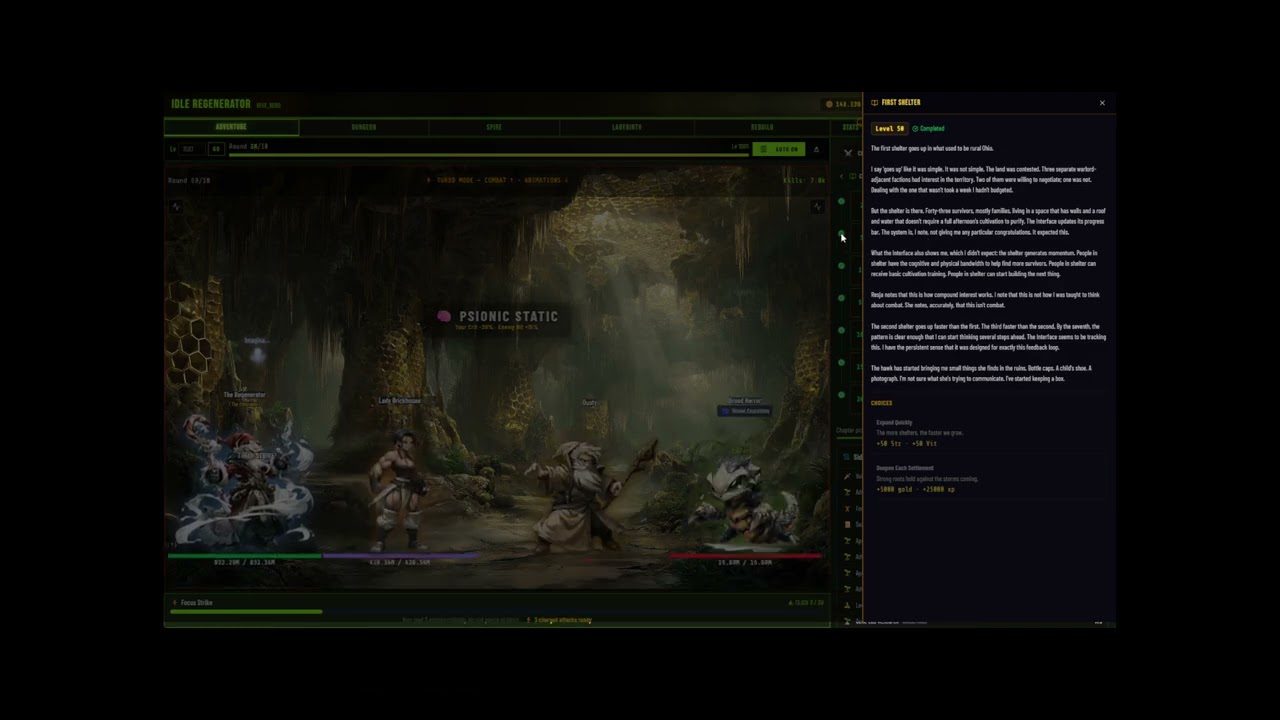
Idle Regenerator arrives as one of the more ambitious entries in the idle‑RPG space, blending incremental progression, roguelite elements, auto‑battler combat, and a constellation‑based meta‑system that promises dozens of hours of growth. On paper, it’s a dream for players who love numbers, optimization, and long‑form progression. In practice, the game succeeds in several areas—but also stumbles in ways that the community has consistently pointed out.
A Strong Start: Depth, Systems, and Visual Identity
From the moment you begin your post‑apocalyptic journey, the game makes its priorities clear: systems, systems, and more systems.
- Over 125 unique powers shape your build and combat identity.
- Multiple progression layers—prestige resets, forging, sidekicks, constellations—stack into a dense web of interlocking mechanics.
- The game features five+ independent modes (Adventure, Dungeon, Heaven Spire, System Labyrinth, Rebuilding), each with its own rewards and progression loops.
Visually, Idle Regenerator opts for clarity over spectacle. Its interface‑heavy presentation is clean, readable, and functional—an intentional choice for a genre where menus matter more than animations. Some art assets were created with AI assistance, a detail the developer openly acknowledges.
Community Praise: Ambition Without Exploitation
One of the most widely appreciated aspects is what the game doesn’t do:
- No microtransactions
- No energy timers
- No pay‑to‑win currencies
Steam’s official description reinforces this philosophy, emphasizing “Just depth.” For a genre often plagued by monetization traps, this is refreshing—and a major reason some players defend the game despite its flaws.
Where the Cracks Show: Repetition and Mechanical Fatigue
Despite its impressive breadth, the game’s long‑term engagement suffers from a familiar idle‑genre pitfall: repetition.
Across reviews, the consensus is that Idle Regenerator’s systems are deep but not dynamic. Once you understand the loops, the game becomes more about watching numbers rise than making meaningful decisions.
A particularly blunt review notes that after the first ten minutes, “there wasn’t really much to do… I could just sit there and let it run.” This sentiment echoes across user discussions: the game’s complexity doesn’t always translate into active engagement.
Technical Issues: Prestige System & Save Exploits
One reviewer highlighted a major flaw: the prestige system can be abused, allowing players to unlock major upgrades in minutes simply by repeatedly resetting. Additionally, save files stored as JSON can be manually edited to grant massive progression instantly—undermining the intended long‑term grind.
These issues contribute to the perception that the game’s depth is more structural than experiential.

Final Verdict — A Passionate Attempt With Noticeable Limitations
Idle Regenerator is a fascinating case study: a game overflowing with ideas, systems, and ambition, yet unable to escape the gravitational pull of idle‑game repetition. Its graphics and interface are polished, its progression layers are impressively interconnected, and its anti‑monetization stance is commendable.
But the experience eventually plateaus. Once the player internalizes the loops, the game becomes more passive than strategic, and its mechanical flaws—particularly the prestige exploit—undercut the sense of earned progression.
If you love idle games and want something deeper than the usual mobile fare, Idle Regenerator is worth a look. If you crave active engagement or evolving gameplay, its repetition may wear you down.