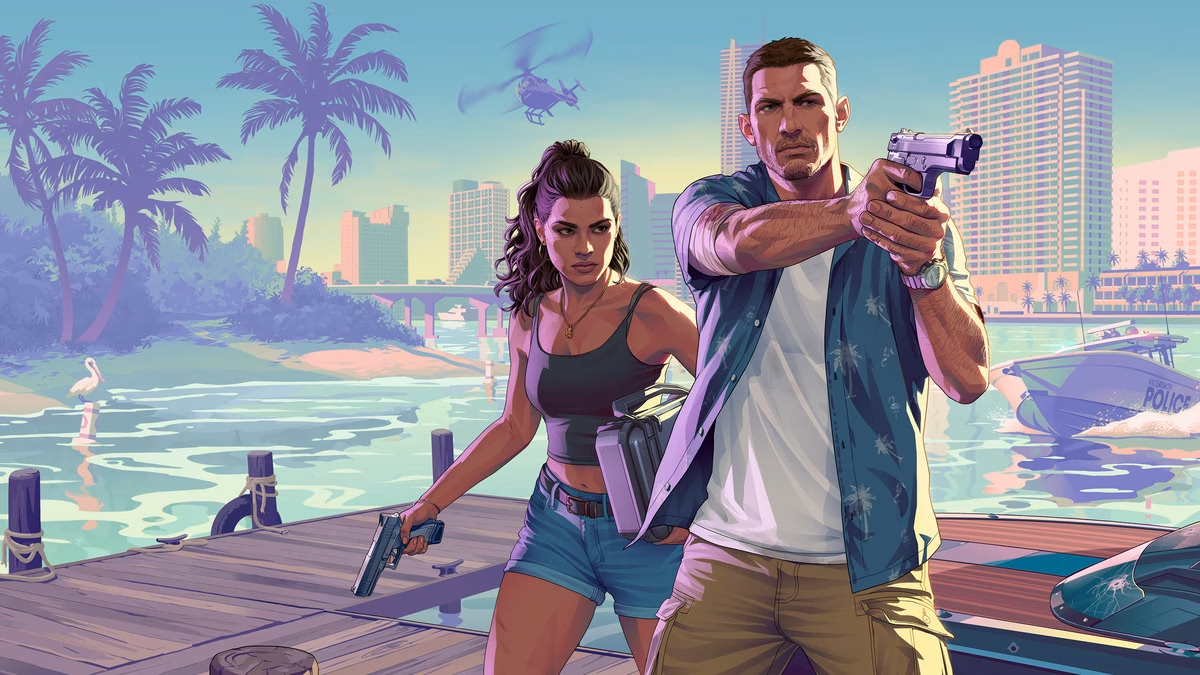
For more than a decade, the gaming world has lived in the gravitational pull of Grand Theft Auto V—a title so commercially dominant and culturally omnipresent that its successor has become less a game and more a myth. Now, as Grand Theft Auto VI inches toward its long‑awaited November 2026 release window, Take‑Two Interactive CEO Strauss Zelnick finds himself confronting a paradox: the closer the finish line gets, the more daunting the expectations become.
In recent interviews, Zelnick has been unusually candid about the emotional and strategic weight surrounding Rockstar’s next epic. Speaking with Bloomberg, he described the experience of watching GTA VI’s final stretch from the executive sidelines as “exciting” but also “terrifying,” acknowledging that the bar set by fans—and by Rockstar’s own legacy—has never been higher. His comments reflect a rare moment of vulnerability from a company that typically communicates with the confidence of a studio that has reshaped open‑world gaming multiple times over.
A Decade of Build‑Up: How GTA VI Became the Most Pressurized Game in Modern History
Rockstar began conceptual work on GTA VI not long after GTA V’s 2013 launch, but the studio’s priorities shifted dramatically as GTA Online exploded into a multibillion‑dollar live‑service phenomenon. What was once expected to be a traditional sequel cycle stretched into a marathon of updates, expansions, and platform re‑releases.
Internally, this created a dual challenge: maintaining the world’s most profitable online game while quietly constructing the next generational leap in open‑world design. Developers who spoke anonymously over the years described a project that ballooned in scope, ambition, and technical complexity—one that required new tools, new pipelines, and a new cultural approach after Rockstar publicly committed to reducing crunch.
Leaks in 2022 exposed early development footage, forcing the studio to accelerate communication and reaffirm its long‑term vision. Despite the breach, Take‑Two’s stock surged by more than a billion dollars afterward, a testament to the franchise’s gravitational pull.
By 2024, Rockstar had internally aligned on a release target, but the timeline continued to shift as the studio pushed for what Zelnick calls “something that’s never been experienced before.” That pursuit of perfection—backed by what he describes as “unlimited financial, creative, and human resources”—has defined the project’s identity.
The Delays: Necessary Friction in a Monumental Production
While Rockstar has not publicly labeled its timeline changes as “delays,” the industry has tracked several internal adjustments:
- Early projections suggested a 2024–2025 window.
- Internal restructuring and pipeline overhauls pushed the target further.
- The company now stands firmly behind a November 2026 release.
These shifts reflect the reality of building a game expected to redefine open‑world interactivity. GTA VI’s map—rumored to be the largest and most dynamic in Rockstar’s history—required new AI systems, revamped physics, and a narrative structure designed to evolve over time. The studio’s transition to hybrid work models during the pandemic also contributed to production recalibration.
Zelnick’s recent comments underscore that Take‑Two refuses to declare victory prematurely. The company’s philosophy is simple: Rockstar games are not released when they are ready—they are released when they are perfect.
Why Consoles Come First: The Strategic Logic Behind Rockstar’s Release Order
One of the most debated decisions surrounding GTA VI is Rockstar’s choice to launch on consoles first, with PC following later. Zelnick addressed this directly, dispelling rumors of a PlayStation exclusivity deal and instead framing the move as a return to Rockstar’s historical pattern.
According to him, console players remain Rockstar’s “core consumers,” the audience by which the game will be “judged first and best.” This echoes the studio’s long‑standing philosophy: major Rockstar titles—from GTA III to Red Dead Redemption 2—have traditionally debuted on consoles before expanding to PC.
Zelnick also highlighted a dramatic shift in PC’s importance. When Take‑Two launched the NBA 2K series, PC accounted for just 5% of sales. Today, major titles can see 45–50% of their revenue from PC players.
Even so, Rockstar believes that serving the console base first ensures the strongest possible launch foundation. The PC version, historically more technically demanding, benefits from additional optimization time.
The Weight of Expectation: Why Zelnick Says He’s “Terrified”
Zelnick’s admission of fear is not a sign of weakness—it’s a reflection of the unprecedented cultural pressure surrounding GTA VI.
The franchise is no longer just a blockbuster series; it is a global entertainment event. Every trailer becomes a cultural moment. Every leak becomes a stock‑moving headline. Every rumor becomes a trending topic.
For Take‑Two, the stakes are enormous:
- GTA VI is expected to be the biggest entertainment launch in history.
- Investors view it as a generational revenue anchor.
- Fans expect a leap forward on the scale of GTA III or Red Dead Redemption 2.
Zelnick’s fear is rooted in the knowledge that the world expects nothing less than a revolution—and that Rockstar must deliver it under the brightest spotlight gaming has ever seen.
Where Development Stands Now
As of mid‑2026, Rockstar is deep in the finalization phase:
- Systems are locked.
- Narrative content is undergoing polish.
- Performance optimization is underway for next‑gen consoles.
- PC development continues in parallel, with no announced release window.
The studio’s internal culture has reportedly stabilized after years of restructuring, and Take‑Two leadership remains confident enough to reaffirm the November 2026 target publicly.
The next major milestone is expected to be a new trailer—something fans have been eagerly awaiting as Rockstar fine‑tunes the game’s presentation.
The Road Ahead
GTA VI is more than a sequel; it is a generational handoff. It must honor the legacy of a franchise that has shaped modern gaming while proving that Rockstar can still redefine the medium in an era of live‑service giants, rising development costs, and shifting player expectations.
Zelnick’s fear, in that sense, is not a warning sign—it’s a reminder of the scale of what Rockstar is attempting. The studio is not just making another GTA. It is trying to build the next cultural landmark in interactive entertainment.
And for the first time in years, the finish line is finally visible.