


AMD’s CES 2026 keynote wasn’t about shock announcements or surprise architectures. Instead, the company delivered a confident, tightly focused update across mobile, desktop, and AI‑accelerated computing — a continuation of its “AI Everywhere, for Everyone” strategy. The result is a lineup that leans into efficiency, neural processing, and incremental performance gains rather than sweeping generational shifts.
The centerpiece of the show was the Ryzen AI 400 Series, AMD’s newest mobile platform built on Zen 5 CPU cores, RDNA 3.5 graphics, and the upgraded XDNA 2 NPU. AMD emphasized that these chips are designed for the next wave of Copilot+ PCs, promising faster multitasking and up to 60 TOPS of NPU throughput. While the architectural foundation remains familiar, the refinements target battery life, AI responsiveness, and GPU efficiency — a clear response to Intel’s Core Ultra competition.
Ryzen AI 400 Series — Official Specs
| Category | Ryzen AI 400 Series (Gorgon Point) |
|---|---|
| CPU Architecture | Zen 5 |
| Cores / Threads | Up to 12C / 24T |
| GPU | RDNA 3.5 integrated graphics |
| NPU | XDNA 2, up to 60 TOPS |
| Key Features | Multi‑day battery claims, Copilot+ PC support, improved efficiency |
The pitch is straightforward: more AI throughput, smoother content creation, and better battery life — all without raising platform power envelopes.
Ryzen AI Max+ Series — New SKUs for Workstation‑Class Laptops
AMD also expanded its workstation‑leaning Ryzen AI Max+ family, introducing new processors aimed at creators and professionals who need stronger GPU performance without the thermal footprint of a full H‑series chip. These Max+ processors emphasize graphics and AI acceleration while offering more flexible CPU configurations for OEMs.
Ryzen AI Max+ (Official Highlights)
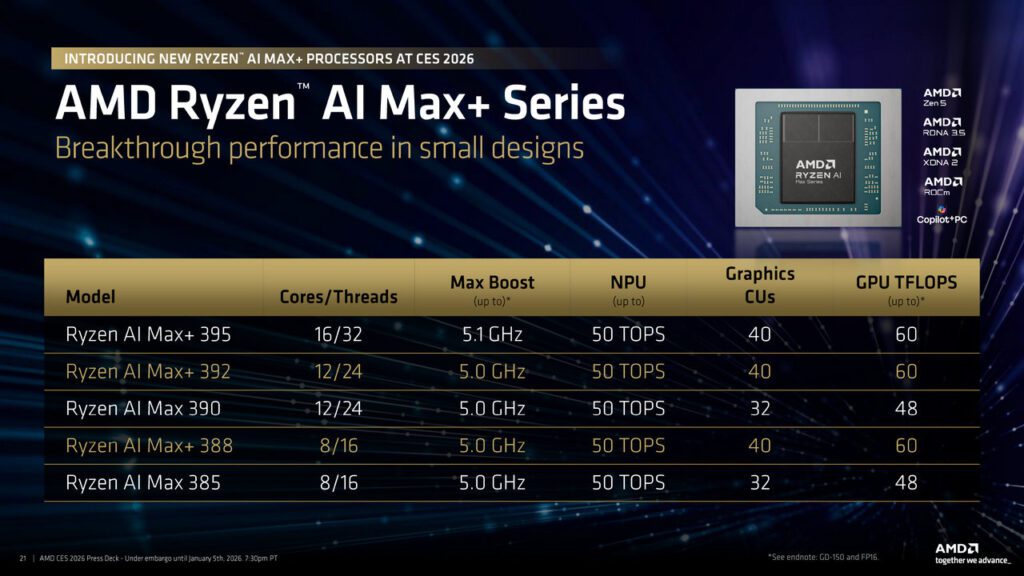
| Category | Ryzen AI Max+ 392 | Ryzen AI Max+ 388 |
|---|---|---|
| CPU | Zen 5 | Zen 5 |
| GPU | Enhanced RDNA 3.5 | Enhanced RDNA 3.5 |
| NPU | XDNA 2 | XDNA 2 |
| Target Device | Creator laptops | Mid‑range AI laptops |
AMD didn’t position these as replacements for the 400 Series, but rather as specialized options for heavier GPU workloads.
Ryzen 7 9850X3D — AMD’s New Gaming Flagship
On the desktop front, AMD confirmed the Ryzen 7 9850X3D, now officially marketed as the world’s fastest gaming CPU. It’s a refined version of the 9800X3D, with higher boost clocks and the same 3D V‑Cache advantage that has defined AMD’s gaming leadership.

Ryzen 7 9850X3D — Official Specs
| Category | Ryzen 7 9850X3D |
|---|---|
| Architecture | Zen 5 |
| Cores / Threads | 8C / 16T |
| Max Boost Clock | +400 MHz over 9800X3D (official uplift) |
| Cache | 3D V‑Cache (96 MB L3) |
| Positioning | Fastest gaming CPU (AMD claim) |
AMD’s internal testing shows a modest 2–3% uplift at 1080p — small, but enough to maintain the performance crown.
AMD also used CES to expand its software ecosystem. ROCm 7.2 now officially supports the entire Ryzen AI 400 lineup, signaling AMD’s intent to unify AI workflows across mobile and desktop hardware.
ROCm 7.2 Support Matrix
| Hardware | ROCm 7.2 Support |
|---|---|
| Ryzen AI 400 Series | ✔️ Official support |
| Ryzen AI Max+ | ✔️ |
| Radeon RX 9000 Series | ✔️ |
| Older Ryzen AI 300 | Partial / limited |
This is a strategic move — AMD wants developers building AI tools that run seamlessly across its entire stack.
FSR Redstone — Next‑Gen Upscaling Arrives

Finally, AMD confirmed that FSR Redstone is now available for all Radeon RX 9000‑series GPUs, with more than 200 games in development pipelines adopting at least one of its features.
FSR Redstone Feature Breakdown
| Feature | Description |
|---|---|
| Radiance Caching | Improved global illumination |
| Ray Regeneration | Faster ray‑traced scene updates |
| Upscaling | Next‑gen spatial/temporal upscaling |
| Frame Generation | AI‑assisted frame interpolation |
Support will vary by game, but AMD is clearly positioning Redstone as a long‑term pillar of its graphics roadmap.
A Strategy of Refinement, Not Reinvention
AMD’s CES 2026 announcements paint a picture of a company doubling down on AI acceleration and platform consistency. No new architectures, no surprise categories — just a steady tightening of the Zen 5 ecosystem and a clear message that AI‑enhanced computing is the new baseline.
It’s a quieter CES for AMD, but a strategically coherent one.






One Comment