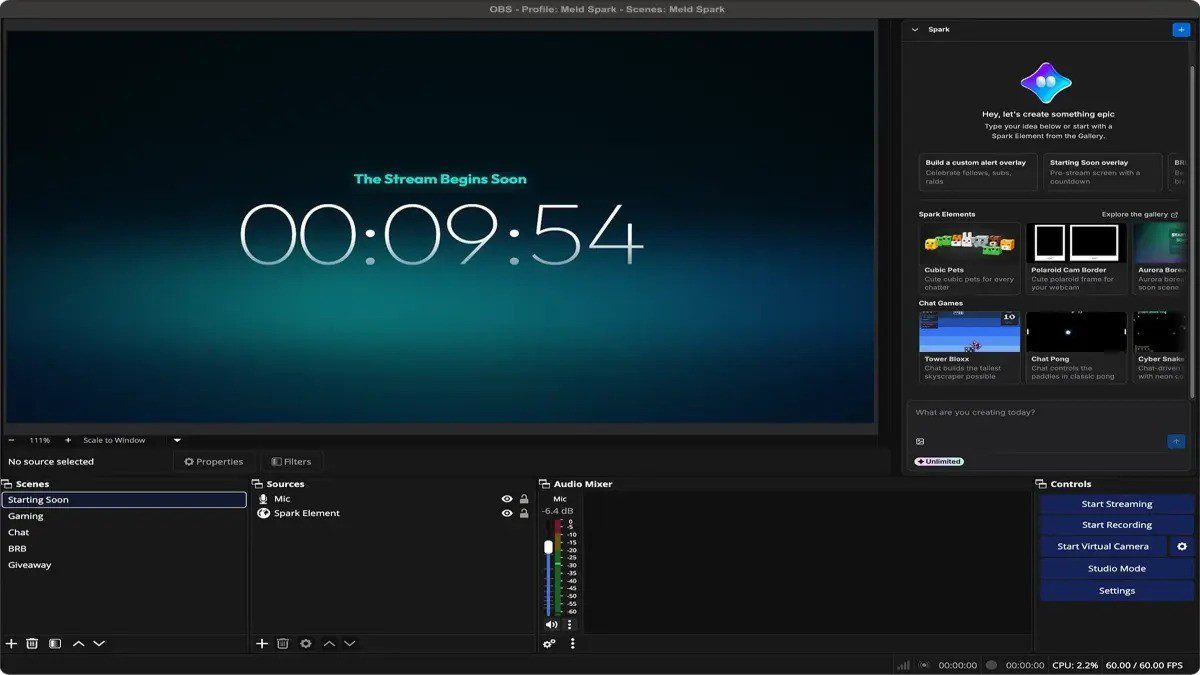
For more than a decade, OBS has been the beating heart of grassroots livestreaming. It’s the tool that powered the rise of Twitch culture, the software that let creators broadcast from bedrooms, dorm rooms, and makeshift studios long before streaming became a polished industry. OBS was always the workhorse: open‑source, endlessly customizable, and powerful in the hands of anyone willing to tinker. But that power came with a cost. To make OBS sing, you had to wire it together yourself — browser sources, alerts, overlays, timers, widgets, plugins, scripts, and the occasional late‑night meltdown when something broke five minutes before going live.
Meanwhile, a new generation of tools emerged promising to simplify the chaos. Meld Studio was one of the most ambitious of them, built not as a competitor to OBS but as a reimagining of what a modern creator platform could be. Meld Spark, their AI‑powered overlay and widget engine, was the centerpiece: a system that could generate dynamic scenes, alerts, chat interactions, and visual elements on the fly. It wasn’t just a library of widgets; it was a creative engine designed to remove friction from the process of building a stream’s identity.
But there was always a divide. OBS users stayed with OBS because it was familiar, powerful, and deeply integrated into their workflow. Meld users embraced the all‑in‑one studio because it felt modern and cohesive. The two worlds didn’t talk to each other — until now.
The release of the Meld Spark Plug for OBS is the moment those worlds finally collide.
Don’t Want To Switch? It’s Fine
What Meld has done is deceptively simple on the surface: a plugin that embeds Spark directly inside OBS, complete with its own panel, login flow, and real‑time creative tools. But the implications run much deeper. For the first time, OBS users can tap into Spark’s ecosystem without leaving the software they’ve built their careers on. The plugin installs once, adds new tabs to OBS automatically, and instantly connects to a creator’s Meld account. From there, Spark becomes a native part of the OBS experience — not a workaround, not a browser hack, but a fully integrated creative layer.
This matters because Spark isn’t just another overlay editor. It’s a system that can generate alerts, chat games, animated tickers, timers, “starting soon” and “BRB” screens, and interactive widgets that respond to platforms automatically. It turns ideas into browser sources in real time, letting creators experiment, iterate, and deploy without juggling multiple tools or windows. OBS becomes the canvas; Spark becomes the brush.
To understand why this is such a big deal, you have to look at the history of both tools. OBS grew up in an era where creators were expected to assemble their own streaming stack. Everything was modular, everything was manual, and everything was possible — if you had the patience. Meld Spark grew up in the era of creator overload, where streamers needed to do more with less time, less stress, and fewer technical barriers. Spark was built to automate the tedious parts of streaming so creators could focus on the performance, not the plumbing.
The Spark Plug is the bridge between those philosophies. It doesn’t replace OBS; it enhances it. It doesn’t force creators into a new ecosystem; it brings the ecosystem to them. And it does so without compromising the openness that made OBS beloved in the first place. The plugin is available for Windows, built for OBS 32.1, and even ships with its source code — a nod to the open‑source spirit that defines the OBS community.
For streamers, this integration means something powerful: the freedom to stay with the tools they trust while gaining access to a new layer of creativity. It means fewer browser sources to manage manually, fewer third‑party sites to juggle, and fewer moments where you wonder why your alert box suddenly stopped working. It means being able to dream up a new overlay idea mid‑stream and bring it to life without breaking your flow. It means OBS finally feels like it has a modern creative engine baked into it, without losing the control and flexibility that made it the industry standard.
Unprecedented As Meld Is Being Look As The True OBS Studio Alternative
And for Meld, this move signals something bigger. Spark is no longer just a feature of Meld Studio — it’s becoming a platform. A platform that can live inside OBS, inside Meld, and potentially inside any tool that wants to give creators more power with less friction. It’s a strategic shift that positions Meld not as a competitor to OBS, but as a collaborator shaping the next era of livestreaming.
The Spark Plug doesn’t announce itself with fanfare. It doesn’t try to reinvent OBS or replace the workflows creators have built over years. Instead, it slips quietly into the software, opens a door, and invites streamers to imagine what their broadcasts could look like if creativity wasn’t slowed down by setup, configuration, or technical overhead.
In a landscape where creators are constantly asked to do more — more content, more platforms, more engagement — this kind of integration is more than a convenience. It’s a relief. It’s a reminder that tools should empower, not overwhelm. And it’s a sign that the future of streaming isn’t about choosing one platform over another, but about building bridges that let creators move freely between them.
OBS gave streamers the power to broadcast. Spark is giving them the power to create. Together, they’re shaping a new chapter in livestreaming — one where ideas move at the speed of imagination, and the tools finally keep up.