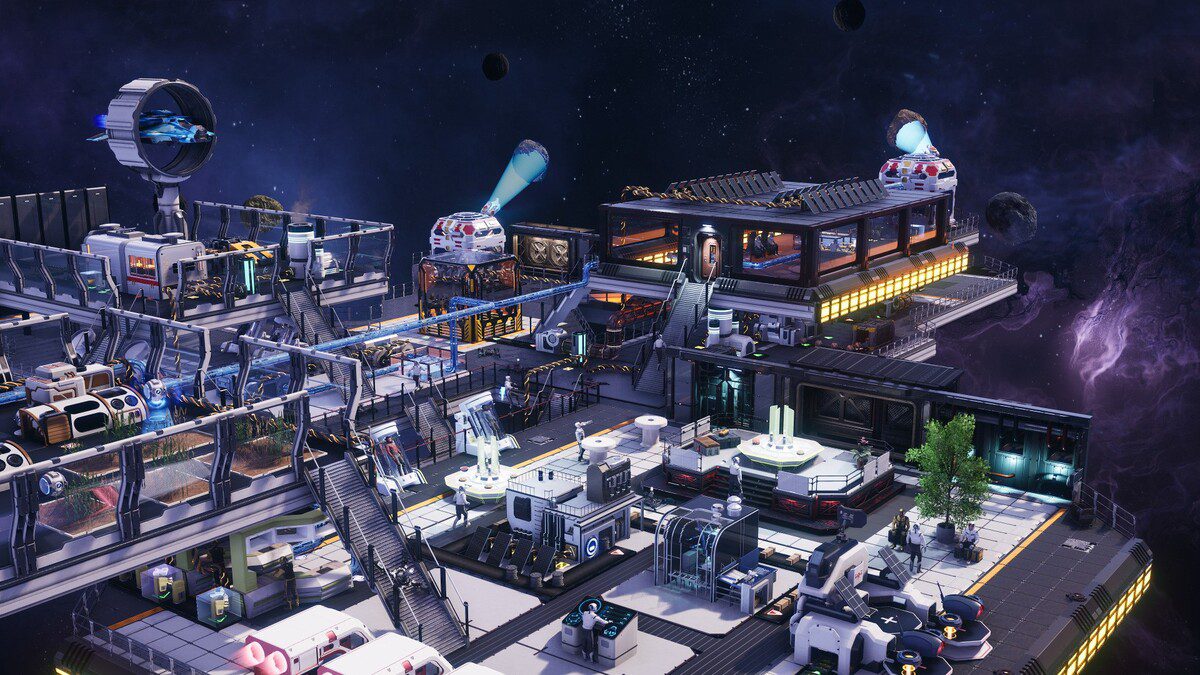
Astro Colony doesn’t scream for your attention the way most modern survival-crafting games do. There’s no dramatic intro, no catastrophic event forcing you into action. Instead, it opens with a gentle invitation: build something beautiful in the endless dark. And that’s the magic of it — a game that trusts you enough to let curiosity be the driving force.
From the moment you drift onto your first voxel planet, the game establishes its identity. Everything is destructible, everything is harvestable, and everything is part of a larger, interconnected machine you’ll eventually design. Astro Colony isn’t about surviving space; it’s about mastering it.
The core loop is deceptively simple: explore, automate, expand. But the execution is where Terad Games shows its craft. Conveyor belts snake through your stations like veins. Pipes carry life-sustaining resources to astronauts who depend on your planning. Research trees — over 70 technologies deep — unlock new layers of complexity without ever overwhelming you. It’s the rare builder that grows with you instead of against you.
What’s unique?
What sets Astro Colony apart is its sense of motion. Stations aren’t static bases; they’re modular, dockable structures you can rearrange like cosmic LEGO. You’re not building a colony — you’re building a constellation. And when those stations link together for the first time, forming a network across procedurally generated planets, the game delivers a quiet, satisfying “click” that few titles in the genre achieve.
The universe itself is a character. Biomes shift from lush alien forests to barren mineral worlds. Plants — hundreds of them — create ecosystems that feel alive. Unexpected events break the calm, reminding you that space isn’t empty; it’s unpredictable. And yet, Astro Colony never punishes you unfairly. It nudges, it surprises, but it never tries to break you.
Co-op elevates the experience. Building with friends transforms the galaxy into a shared engineering playground. One player optimizes production lines while another charts new planets. It’s collaborative, not competitive — a refreshing change from the usual survival chaos.
Performance-wise, Astro Colony is shockingly accessible. Even older hardware handles it well, a testament to smart optimization rather than brute-force graphics. It’s a game that values design over spectacle, and it shows.
The Main Take Away
Astro Colony isn’t trying to be the next big space sim. It’s trying to be your space sim — a place where creativity, automation, and exploration blend into something soothing, clever, and endlessly replayable. It’s the kind of game you boot up for an hour and accidentally play for five.
For players who love building, tinkering, and discovering at their own pace, Astro Colony is a quiet triumph. Not loud, not flashy — just genuinely good.