
The video game industry has spent years talking about accessibility, but one of its biggest challenges has never been creating features. It has been helping players find them.
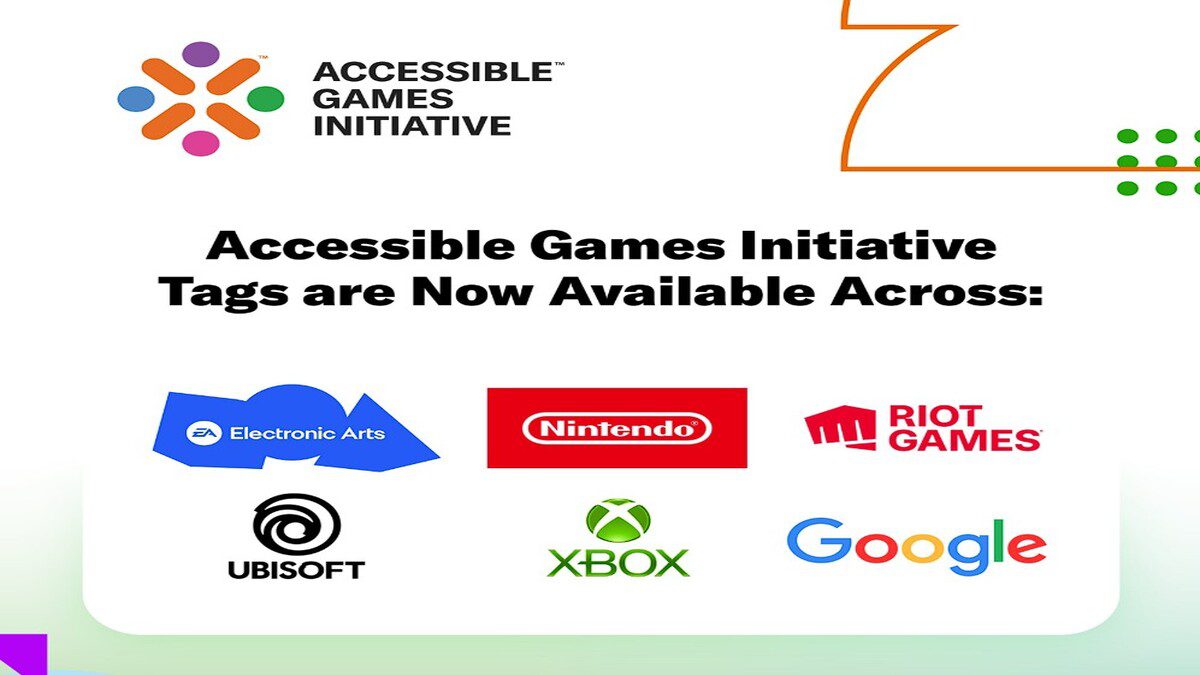
That challenge is now being addressed through a major collaborative effort involving some of gaming’s largest companies. Nintendo, Xbox, Ubisoft, and Electronic Arts have officially adopted the Accessible Games Initiative tags, a standardized labeling system designed to make accessibility features easier to identify before players purchase or download a game. The initiative aims to create a common language across storefronts and platforms, allowing consumers to quickly determine whether a title includes features such as customizable controls, narrated menus, subtitle options, difficulty settings, and other accessibility tools. Accessible Games Initiative was launched by the Entertainment Software Association (ESA) alongside founding partners including EA, Google, Microsoft, Nintendo of America, and Ubisoft.
For many players, this announcement may seem like a simple quality-of-life improvement. In reality, it represents the culmination of a decades-long journey in gaming accessibility and reflects a significant shift in how the industry approaches inclusivity.
Accessibility’s Long Road to Recognition
Video games were not originally designed with accessibility in mind. During the arcade era and the early years of home consoles, developers focused primarily on technological innovation, graphical improvements, and increasingly complex gameplay systems. Accessibility features were rarely discussed, and many players with disabilities found themselves excluded from experiences that others could enjoy without difficulty.
As gaming evolved into a global entertainment medium, awareness of accessibility concerns gradually increased. Developers began implementing subtitles, alternative control schemes, adjustable difficulty settings, and visual aids. However, the adoption of these features varied widely between studios and publishers. One title might include extensive accessibility options, while another offered almost none.
The problem extended beyond feature implementation. Even when accessibility options existed, players often had no reliable way to discover them before buying a game. Information was scattered across reviews, community websites, accessibility advocacy groups, and forum discussions. Consumers frequently had to conduct extensive research simply to determine whether a game supported their specific needs.
This lack of transparency became increasingly difficult to justify as accessibility emerged as a core part of modern game development.
A Standardized Solution for a Growing Industry
The creation of the Accessible Games Initiative was driven by a simple goal: provide clear and consistent information about accessibility features across the industry. The ESA announced the initiative in 2025 with a set of 24 standardized tags, each supported by precise criteria and definitions. These tags are intended to appear on product pages, digital storefronts, and online catalogs, helping players understand available accessibility options before committing to a purchase.
The initiative’s strength lies in its consistency. Rather than relying on marketing language that can vary dramatically between publishers, the tags establish a universal framework. Whether a player is browsing a Nintendo game, an Xbox title, or a Ubisoft release, the terminology remains the same. This consistency reduces confusion and allows consumers to make informed decisions based on their individual requirements.
The standardized system also benefits developers. Instead of creating unique accessibility descriptions for different storefronts and platforms, studios can communicate their features through a shared industry-recognized language. This approach streamlines communication while encouraging accessibility considerations earlier in the development process.
Why Industry-Wide Adoption Matters
Perhaps the most remarkable aspect of the initiative is the level of cooperation behind it.
Historically, platform holders and publishers have competed aggressively for market share, exclusives, and ecosystem loyalty. Nintendo, Microsoft, Ubisoft, and Electronic Arts each operate within highly competitive segments of the gaming business, yet accessibility has become an area where collaboration outweighs competition.
The adoption of Accessible Games Initiative tags by multiple major companies signals a broader industry recognition that accessibility should not be treated as a competitive advantage but as a shared responsibility. The more widespread the standard becomes, the more useful it becomes for players.
Recent expansion efforts have already brought additional participants into the initiative. Companies including Riot Games and Google have begun implementing the tags, further extending their reach across the gaming landscape and helping create a more unified approach to accessibility information.
Building on Years of Accessibility Progress
The initiative did not emerge in isolation. It builds upon years of accessibility advocacy and technological advancement across the industry.
Many modern titles now offer features that would have been unimaginable just a decade ago. Comprehensive subtitle customization, scalable interface elements, remappable controls, narrated menus, colorblind support, audio accessibility settings, and adaptive controller compatibility have become increasingly common. Major publishers have invested significant resources into designing games that accommodate a wider range of physical, sensory, and cognitive needs.
Microsoft, in particular, helped popularize accessibility transparency through its earlier Xbox Accessibility Feature Tags program, which laid important groundwork for broader industry standardization. The Accessible Games Initiative expands upon that concept by moving beyond a single ecosystem and creating a framework capable of serving the entire industry.
The result is an approach that not only highlights accessibility features but also makes them easier to understand across different platforms and storefronts.
A Better Future for Game Discovery
At its core, the Accessible Games Initiative is not about changing how games are played. It is about changing how games are discovered.
Players should not have to search through forums, reviews, and community discussions just to find out whether a title offers readable subtitles, customizable controls, or menu narration. By providing consistent accessibility information at the point of purchase, participating companies are removing barriers long before gameplay even begins.
As more publishers and storefront operators adopt the system, the Accessible Games Initiative has the potential to become one of the most influential accessibility developments in gaming history. Its success will not be measured solely by the number of tags displayed on product pages, but by the number of players who are finally able to identify games that meet their needs without unnecessary research or uncertainty.
For an industry that often speaks about breaking down barriers, Nintendo, Xbox, Ubisoft, and EA’s embrace of accessibility tags represents something tangible: a step toward ensuring that the simple joy of discovering a game is available to everyone.