
Microsoft is pushing Xbox Cloud Gaming into a new era. With the announcement of two new preview features, Xbox is taking another major step toward making cloud gaming feel less like a streaming compromise and more like a native gaming platform. The company is now testing a phone-based controller solution for Smart TVs and introducing an entirely new piece of hardware, the Xbox Nano Controller, designed specifically for cloud gaming.
For longtime cloud gaming enthusiasts, the second announcement feels particularly familiar. The Xbox Nano Controller’s direct-to-cloud connection strategy closely resembles one of the most innovative ideas ever launched in the gaming industry: Google Stadia’s Wi-Fi-connected controller.
The comparison is impossible to ignore, and perhaps that’s exactly the point.
Xbox Cloud Gaming Expands Beyond Traditional Controllers
According to Xbox Wire, Microsoft has begun rolling out two cloud gaming previews. The first allows players to use an Android or iOS phone as a controller when playing Xbox Cloud Gaming on supported Smart TVs. Instead of requiring a physical controller, users can access touch controls directly through their phone’s web browser. Some games will even feature controls specifically designed around mobile interaction.
This feature addresses one of cloud gaming’s most common barriers: convenience.
A family member visits and wants to play? The controller battery is dead? The Xbox controller is sitting somewhere in another room? Now, a smartphone can fill the gap instantly.
The move aligns with Microsoft’s broader vision of allowing Xbox games to be played virtually anywhere, on almost any device.
Meet the Xbox Nano Controller
The second preview is arguably the bigger story.
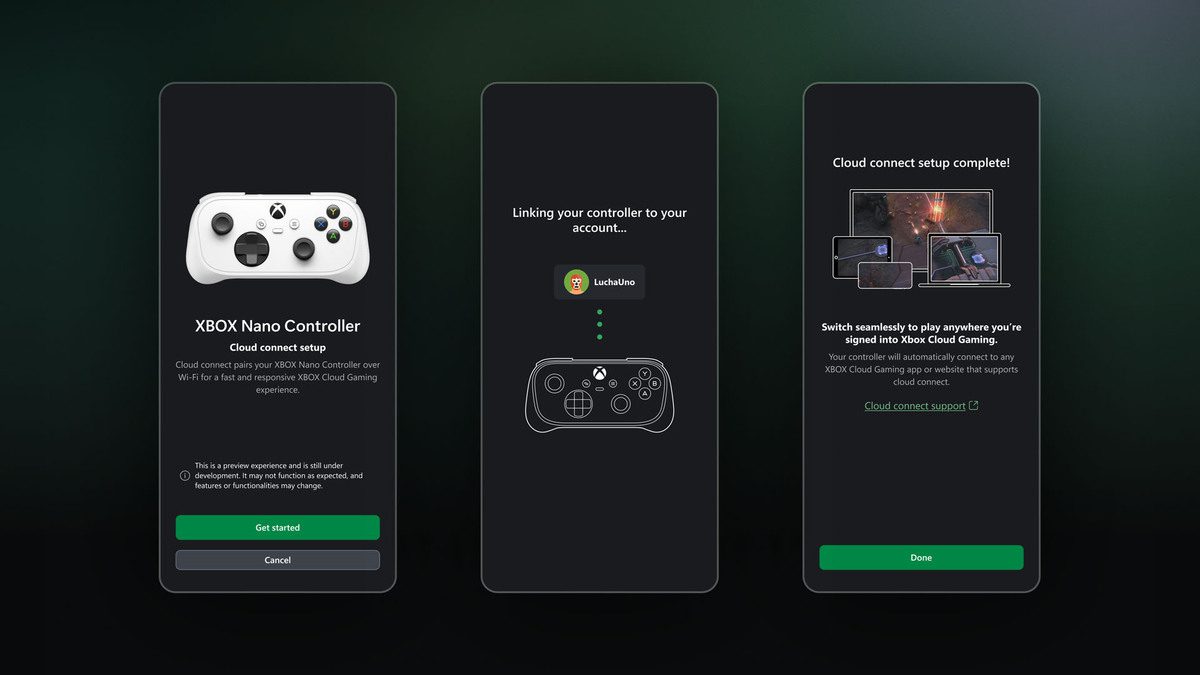
Microsoft is allowing U.S. players to test Cloud Connect using the newly announced Xbox Nano Controller. Unlike traditional Bluetooth controllers, the Nano connects directly to Xbox Cloud Gaming servers through Wi-Fi. Microsoft says this can help reduce input latency and make games feel more responsive.
To enable the feature, players configure the Nano Controller through the Xbox Beta App on Android or Xbox Accessories App on PC before connecting it to a Wi-Fi network. Once linked to the same Xbox account used for cloud gaming, the controller communicates directly with Microsoft’s cloud infrastructure rather than routing commands through a television or streaming device.
That architecture may sound familiar.
The Stadia Controller Comparison Nobody Can Avoid
When Google launched Stadia in 2019, its greatest technical innovation was not the streaming technology itself.
It was the controller.
Unlike Xbox controllers, PlayStation controllers, or most Bluetooth devices, the Stadia Controller connected directly to Google’s servers over Wi-Fi. This bypassed local hardware and eliminated an entire layer of communication between player input and the game running in the cloud.
The result was lower latency and a more responsive experience.
At the time, many industry analysts considered the idea one of Stadia’s smartest engineering decisions.
The problem was never the technology; it was Stadia itself.
A lack of compelling exclusives, uncertain publisher support, inconsistent messaging, and concerns about game ownership ultimately led to Stadia’s shutdown in January 2023.
Yet many of Stadia’s best ideas never truly disappeared.
Microsoft appears to be bringing one of them back.
Xbox Nano Controller vs Stadia Controller
From a technological perspective, the similarities are difficult to overlook.
Direct Cloud Connectivity
The Xbox Nano Controller and Stadia Controller share the same fundamental philosophy:
Instead of connecting locally via Bluetooth and then relaying commands through a television or streaming device, both controllers establish a direct Wi-Fi connection with cloud servers.
This can reduce latency and deliver faster input response.
Built for Cloud-First Gaming
Most controllers today are designed primarily for consoles, PCs, and mobile devices.
Both Stadia’s controller and Microsoft’s Nano are engineered specifically with cloud gaming as the centerpiece rather than a secondary feature.
Reduced Hardware Dependence
The cloud-connected approach means the controller becomes less dependent on the device displaying the game. In theory, any compatible screen becomes a gaming platform.
That concept was central to Stadia’s original vision and appears to be equally important in Microsoft’s long-term cloud ambitions.
Where Xbox Has a Major Advantage Over Stadia
While the hardware concepts are remarkably similar, Microsoft’s overall ecosystem gives Xbox advantages that Stadia never achieved.
Massive Existing User Base
Google launched Stadia as an entirely new platform.
Microsoft is adding cloud functionality to an ecosystem that already includes Xbox consoles, Game Pass subscribers, Windows PCs, Smart TVs, and millions of existing Xbox accounts.
A Deep Content Library
Players already own games within the Xbox ecosystem and subscribe to Game Pass. Microsoft isn’t asking gamers to abandon their libraries and start over.
This solves one of Stadia’s biggest adoption challenges.
Multiple Ways to Play
An Xbox game can be played on console, PC, cloud, handheld devices, Smart TVs, or streamed from owned titles.
Stadia largely depended on cloud access as its primary value proposition.
Established Developer Relationships
Microsoft’s decades-long position within gaming provides significantly stronger publisher support than Google was able to secure during Stadia’s lifespan.
Why This Could Be a Turning Point for Cloud Gaming
Cloud gaming has spent years fighting the perception that it is merely a convenient backup option rather than a primary way to play.
The introduction of the Xbox Nano Controller signals that Microsoft may be preparing for a future where cloud gaming stands on equal footing with traditional hardware.
Latency has always been the biggest technical criticism of game streaming. By eliminating Bluetooth communication and connecting directly to cloud servers through Wi-Fi, Microsoft is targeting one of the technology’s most persistent weaknesses.
This isn’t just a new controller.
It’s an acknowledgment that cloud gaming requires dedicated hardware and tailored solutions rather than simply adapting existing console accessories.
The Future Xbox Has Been Building Toward
For years, Xbox executives have described a future where players can access their games from virtually any screen.
Accounting the phone-controller preview makes casual access easier, the Xbox Nano Controller makes cloud gaming more responsive and all that together, they represent two different pieces of the same strategy.
Ironically, that strategy looks increasingly similar to the cloud-first vision Google attempted with Stadia years ago.The difference is that Microsoft isn’t building that vision from scratch.
It already has the ecosystem, the games, the infrastructure, and the audience.
If the Xbox Nano Controller delivers the latency improvements Microsoft is promising, the industry may soon witness something unexpected:
The most successful part of Stadia’s legacy could end up living on through Xbox Cloud Gaming.
