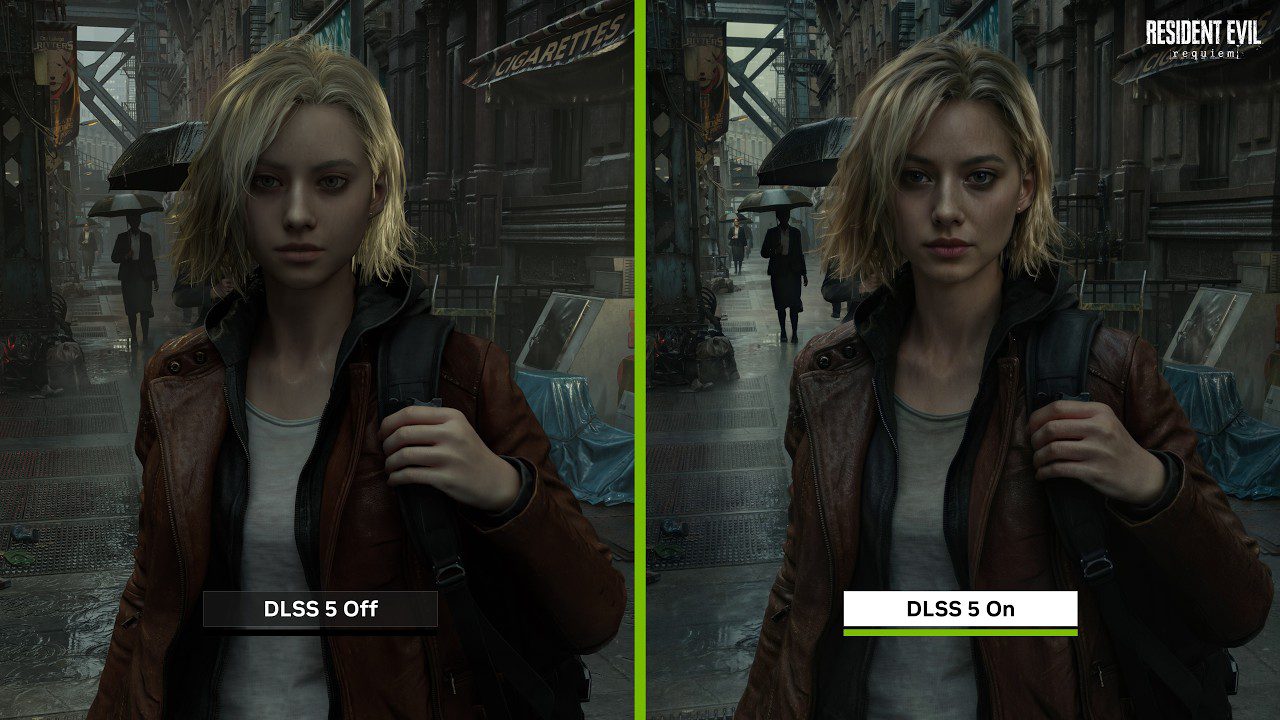
Nvidia’s unveiling of DLSS 5 was meant to be a triumphant moment—a declaration that the company had once again redefined the boundaries of real‑time graphics. Instead, the announcement ignited one of the most polarized debates the PC gaming community has seen in years. What Nvidia framed as a generational leap forward, many players and artists immediately labeled as an intrusive AI filter masquerading as innovation.
At the heart of the controversy is DLSS 5’s new mission: not just to upscale frames or reconstruct pixels, but to actively alter a game’s visuals. Nvidia describes the technology as an AI model capable of infusing scenes with “photoreal lighting and materials,” using color and motion vectors as its raw ingredients. The company positioned this as a bridge between traditional rendering and Hollywood‑grade visual effects, a step beyond the pixel‑prediction approach of DLSS 4.5. In Nvidia’s own words, this is the “GPT moment for graphics,” a fusion of handcrafted artistry and generative AI intended to elevate realism to unprecedented levels.
But the moment the comparison footage hit social media, the tone shifted dramatically. Instead of marveling at the lighting improvements, many viewers fixated on how characters suddenly appeared airbrushed, smoothed, or outright transformed. Critics argued that DLSS 5 didn’t just enhance a game’s look—it imposed a new one. Developers and artists were among the first to voice concern. Rendering engineers described the output as an overbearing mix of contrast and sharpness, while concept artists lamented the loss of original art direction, calling the results “a garbage AI filter” that stripped scenes of personality. Their frustration wasn’t subtle; it was a warning that the technology risked flattening artistic identity in favor of algorithmic gloss.
Players echoed those sentiments with equal intensity. Many compared the effect to the beautification filters that have dominated social media for years—tools that smooth skin, brighten eyes, and homogenize faces into a single aesthetic. The resemblance was uncanny enough that some gamers joked that DLSS 5 seemed determined to “yassify” every character it touched. Others expressed discomfort at how the AI appeared to sexualize or glamorize models in ways that clashed with the tone of the original games. The reaction wasn’t just skepticism; it was a visceral rejection of the idea that AI should reinterpret a developer’s artistic intent.
Yet despite the backlash, major studios are already lining up behind the technology. Bethesda Game Studios publicly endorsed DLSS 5 on day one, confirming that Starfield and future titles—including the next entries in the Fallout and Elder Scrolls franchises—will integrate the new system. Todd Howard praised the technology as a natural evolution of the studio’s long partnership with Nvidia, arguing that DLSS 5 allows their artistic style to shine without being constrained by real‑time rendering limits. For Bethesda, the promise of richer lighting and more detailed materials appears to outweigh the concerns raised by the community.
This divide—between developers eager to push visual fidelity and players wary of AI overreach—has become the defining narrative of DLSS 5’s debut. Nvidia insists that studios will retain full control, with the ability to tune intensity, masking, and color to preserve each game’s identity. But critics argue that the very premise of AI‑altered frames introduces a philosophical shift: a move away from representing what artists created, and toward representing what an algorithm thinks they should have created.
As DLSS 5 prepares for its fall rollout, the gaming world finds itself at a crossroads. On one side is the promise of unprecedented realism, powered by neural rendering that could reshape the future of graphics. On the other is a growing fear that AI may begin to overwrite the human touch that gives games their soul. Nvidia may have delivered a technological breakthrough—but whether it becomes a celebrated milestone or a cautionary tale will depend on how developers wield it, and whether players ultimately accept a future where AI doesn’t just enhance games, but transforms them.
🟩 What Nvidia Announced at GTC 2026
Nvidia unveiled DLSS 5 during its GTC 2026 keynote, presenting it as the next evolution of Deep Learning Super Sampling. Unlike previous versions that focused on upscaling or frame generation, DLSS 5 introduces 3D‑Guided Neural Rendering, a system that analyzes the scene in real time—faces, materials, lighting—and then re‑shades the final image using AI. Nvidia claims this allows games to reach a level of photorealism previously achievable only in Hollywood VFX pipelines.
Jensen Huang emphasized that DLSS 5 represents a reinvention of computer graphics, echoing the company’s milestone moments like the invention of the programmable shader. Nvidia says the technology “infuses pixels with photoreal lighting and materials,” effectively blending traditional rendering with generative AI to create richer, more realistic scenes.
🟩 Key Features Nvidia Highlighted
Nvidia’s messaging centers on DLSS 5 being more than an upscaler. It is described as a neural renderer capable of:
- Understanding the geometry and materials in a scene
- Re‑lighting characters and environments
- Enhancing details like skin, fabric, and reflections
- Applying AI‑driven shading on top of the game’s native rendering
PCWorld reports that Nvidia internally refers to this as a “GPT moment for graphics,” underscoring how deeply generative AI is now embedded into the rendering pipeline.
🟩 Launch Window and Hardware
DLSS 5 is scheduled to launch in fall 2026, optimized for the upcoming RTX 50‑series GPUs, though Nvidia has not yet detailed backward compatibility. The company showcased the technology running in titles like Starfield and Hogwarts Legacy during the reveal.
🟩 Why This Announcement Matters
Nvidia is framing DLSS 5 as a paradigm shift: a move from enhancing pixels to re‑imagining them. This is why the announcement has sparked such intense debate—because the technology doesn’t just improve a game’s visuals; it changes them. But from Nvidia’s perspective, this is the future of real‑time graphics: AI‑augmented rendering that closes the gap between game engines and cinematic production.
If you want, I can break down how DLSS 5 differs from DLSS 4.5, or explain why the announcement triggered such a strong backlash from gamers and artists.