When IO Interactive announced that it had “regained full ownership” of Project Fantasy, the statement landed with the weight of a studio reclaiming its destiny. The Danish developer, best known for Hitman and the critically acclaimed 007: First Light, confirmed that its partnership with an external financier had ended — a financier widely reported to be Microsoft’s Xbox division, which had quietly stepped away from the project during its sweeping 2026 restructuring.
The news didn’t arrive in isolation. It followed a turbulent week in which Xbox revealed 3,200 layoffs and a strategic retreat from projects that didn’t align with its highest-priority franchises. Project Fantasy, an ambitious online RPG built as a long-term live-service world, fell outside that narrowed scope. Bloomberg’s reporting indicated that Xbox had originally agreed to fund and publish the game, but the deal dissolved as part of the platform’s reset.
IO Interactive, for its part, chose not to publicly name the partner — but the studio’s actions spoke louder than any confirmation. The end of the deal forced IO to confront a familiar crossroads: compromise its independence or shoulder the full financial burden of a massive new IP.
It chose independence.
The Long Road to Autonomy
To understand why IO’s decision resonates, it’s necessary to revisit the studio’s history. In 2017, IO Interactive executed a management buyout from Square Enix, regaining the rights to Hitman and becoming one of the industry’s rare fully independent AAA developers. That autonomy became a defining part of its identity — a badge of honor in a landscape dominated by conglomerates and platform holders.
The partnership with Xbox on Project Fantasy was, in many ways, an exception. The game’s scale demanded resources beyond what IO could comfortably sustain alone. Early reports dating back to 2021 described the project as a dragon-themed multiplayer experience, later confirmed in 2023 as a high-fantasy online RPG designed to evolve over many years.
The collaboration promised stability, reach, and the kind of long-term funding that live-service worlds require. But when Xbox began reevaluating its portfolio under new leadership, Project Fantasy became one of the casualties of a broader corporate contraction.
The Fallout: Istanbul Studio Closure and Internal Restructuring
The end of the partnership triggered immediate consequences. IO Interactive announced the closure of its Istanbul studio — a location opened in March 2023 as part of the company’s expansion phase — and began a process of parting ways with staff across multiple teams.
The studio framed the restructuring as a painful but necessary recalibration. Without external funding, IO needed to consolidate around its core franchises: Hitman, 007: First Light, and now Project Fantasy, which it would self-fund “amongst our other projects.”
The message was clear: IO would not abandon the RPG, but it would have to shrink to survive.
In its public statements, the company emphasized its commitment to supporting affected employees and appealed to the broader industry to help place displaced talent. The tone was somber, acknowledging the human cost of maintaining independence in an era of corporate volatility.
What Project Fantasy Actually Is — And Why IO Won’t Let It Go
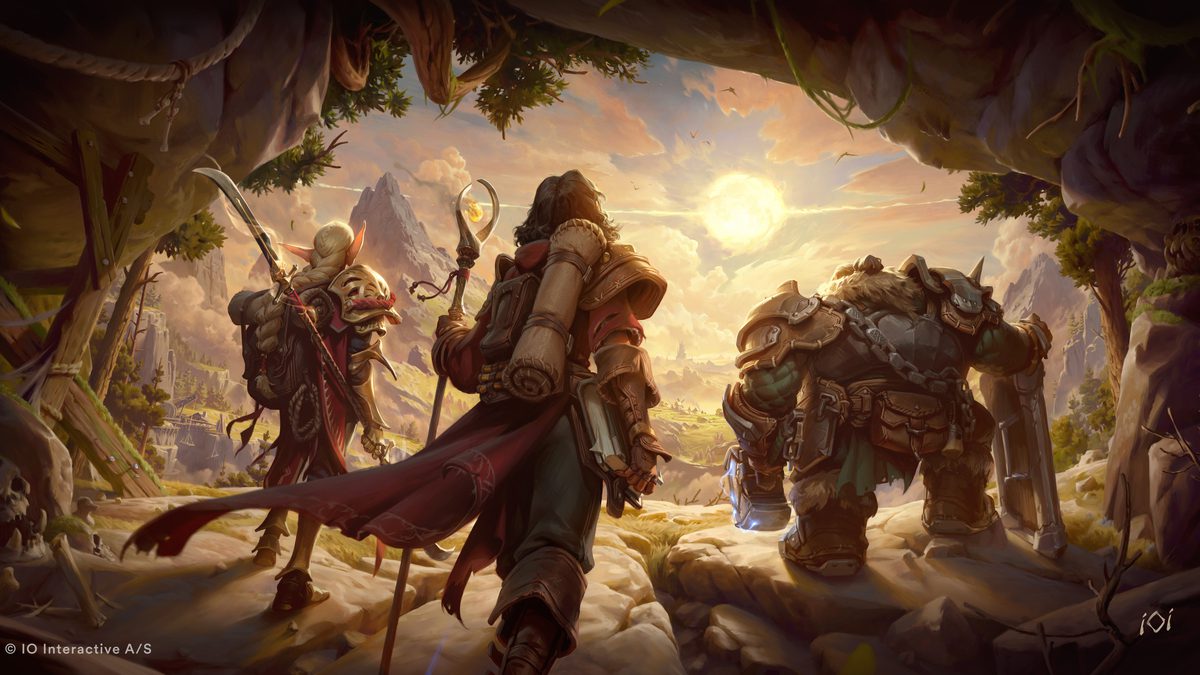
Despite the turmoil, IO Interactive’s passion for Project Fantasy remains unwavering. The studio describes the game as an online fantasy action RPG set in a classic high-fantasy world populated by elves, humans, dwarves, sweeping plains, armor-clad adventurers, and party-based journeys. The project draws inspiration from the Fighting Fantasy books and the appeal of diverse characters working together in a shared world.
This isn’t a grimdark reinvention of fantasy tropes. It’s a love letter to collaborative adventuring — a world built to grow, evolve, and sustain itself over many years. IO’s commitment to the IP suggests that the studio sees Project Fantasy not just as a game, but as a future pillar of its identity.
The decision to self-fund is bold, especially for a studio that has never shipped a game in this genre. Live-service RPGs require enormous investment, continuous content pipelines, and long-term infrastructure. Losing Xbox means losing not only money, but also publishing reach and platform support.
Yet IO’s leadership believes the project is worth the risk.
The Industry Context: A Studio Swimming Against the Current
The timing of IO’s move is striking. The gaming industry in 2026 is defined by consolidation, layoffs, and risk aversion. Platform holders are tightening their portfolios. Publishers are shelving experimental IPs. Studios are closing or being absorbed at unprecedented rates.
IO Interactive is doing the opposite.
Rather than seeking another publisher or scaling down the project, the studio is doubling down on independence — even at the cost of closing offices and reducing staff. It is a stance reminiscent of its 2017 rebirth, a refusal to let external forces dictate its creative future.
In an era where AAA independence is nearly extinct, IO’s decision feels almost defiant.
What Comes Next for IO Interactive and Project Fantasy
The road ahead is uncertain. Self-funding a massive online RPG is a monumental undertaking, and IO will need to balance development with ongoing support for Hitman and 007: First Light. But the studio’s messaging is resolute: Project Fantasy will continue, and it will do so under IO’s full creative control.
The closure of the Istanbul studio marks the end of an expansion phase and the beginning of a survival phase — one focused on protecting the studio’s long-term future and ensuring that Project Fantasy has the foundation it needs to succeed.
If IO Interactive succeeds, it will stand as one of the few remaining fully independent AAA developers with a self-funded live-service RPG — a rarity in modern gaming.
If it fails, it will be because it chose autonomy over compromise.
Either way, the decision to reclaim Project Fantasy is a defining moment for the studio, a reaffirmation of the philosophy that has guided IO since it broke free from Square Enix nearly a decade ago.